The Platform

One workspace. A team of AI agents. Every case, end to end.

A purpose-built workspace where specialist agents draft the work, cite every claim to its source, and route every output through a mandatory attorney review gate.

Client-consented accessEvery output cited to sourceAttorney review required on every send
How it works

One repeatable pipeline. Every workflow.

Every agent — liability, damages, discovery, settlement — runs the same six-step loop. Case files sit on encrypted, access-controlled infrastructure; finished work product is delivered into your firm’s own cloud storage.

  1. Step 1

    Ingest

    Your files land in the workspace on encrypted, access-controlled infrastructure.

  2. Step 2

    Extract

    Structured facts pulled from each document, with page-level citations.

  3. Step 3

    Assess

    Liability, damages, and valuation models score the matter.

  4. Step 4

    Flag risks

    Statutes, coverage gaps, missing records, conflicts surfaced early.

  5. Step 5

    Draft

    The relevant agent drafts the work product — letter, memo, response.

  6. Step 6

    Attorney review

    Nothing leaves the workspace until a licensed attorney signs off.

In the workspace: encrypted, access-controlled storage of case files, exhibits, and the audit log.Delivered out: finished work product into your firm’s own cloud (Dropbox today; Google Drive, OneDrive, SharePoint planned).
Cited to source

Every claim points back to the page it came from.

Hover any fact in any draft and the underlying citation surfaces — police report page, ER note, MRI report. There is no floating prose: if it isn’t cited, it isn’t in the draft.

Meet the agent team

Specialist agents. One supervising attorney.

Each agent is a focused workflow with its own deliverable, citations, and review gate. Together they cover the full plaintiff PI lifecycle. Every agent is decision-support for a licensed attorney — never a substitute for legal judgment.

Intake & Triage

Ingests intake forms, accident reports, and initial documents to triage a new matter — including Attorney-Ready File bundles imported from the claimant app.

Core

Shipping today on the primary case path.

Drafts
Intake summary, risk score, conflict flags, recommended assignment.
Cites
Intake form fields, police report, prior matter conflicts, client-documented submissions.
Attorney approves
Accept / decline and attorney assignment.

Medical Records

Orders, tracks, and organizes medical records with a running status per provider.

Core

Shipping today on the primary case path.

Drafts
Records inventory, outstanding-requests queue, provider index.
Cites
Signed HIPAA authorizations, provider correspondence, batch metadata.
Attorney approves
Request scope and outgoing HIPAA authorizations.

Medical Chronology

Builds an indexed medical chronology, identifies treatment gaps, and pulls causation language.

Core

Shipping today on the primary case path.

Drafts
Provider list, treatment timeline, gap analysis, causation excerpts.
Cites
Each medical record by provider, page, and date of service.
Attorney approves
Narrative framing and missing-records calls before they go out.

Investigation & Liability

Builds the theory of the case, identifies defendants, coverage, witnesses, and outstanding records — comparative-fault-aware.

Core

Shipping today on the primary case path.

Drafts
Liability narrative, defendant/coverage chart, records-request queue, theory-of-case memo.
Cites
Police report pages, witness statements, photo metadata, scene diagrams, coverage letters.
Attorney approves
Theory of the case, investigative scope, and any contested liability calls.

Demand

Drafts demand packages from the medical chronology, liability file, and valuation worksheet — every claim cited.

Core

Shipping today on the primary case path.

Drafts
Demand letter, exhibit binder, transmittal, counter-offer matrix.
Cites
Liability narrative, medical chronology, valuation, prior offers.
Attorney approves
Edits and the send.

Deadlines & Tickler

Applies jurisdictional rules — SOL, notice, discovery cutoffs — to generate a tickler with a tamper-evident chain.

Core

Shipping today on the primary case path.

Drafts
Per-matter deadline stack, tickler queue, upcoming-week digest.
Cites
Statute + rule references, verified-rule provenance, matter-opening dates.
Attorney approves
Every derived deadline. Nothing is scheduled without attorney confirmation.

Pleadings

Drafts complaints, answers, and amended pleadings against your firm's templates and case theory.

Expanding

Released in phases behind the same review gate.

Drafts
Pleading drafts with exhibit references, filing-ready packages.
Cites
Case theory, jurisdictional captions, exhibit locators.
Attorney approves
Every pleading before caption, signature, or filing.

Discovery

Drafts and reviews RFPs, interrogatories, RFAs, and produces objection-ready responses.

Expanding

Released in phases behind the same review gate.

Drafts
Discovery requests, response drafts, privilege log entries.
Cites
Rule citations and the underlying documents being produced or withheld.
Attorney approves
Objections, verifications, and final service.

Depositions

Builds outlines, exhibit binders, and post-deposition summaries.

Expanding

Released in phases behind the same review gate.

Drafts
Witness outline, exhibit list, deposition summary draft.
Cites
Underlying exhibits and transcript line/page numbers.
Attorney approves
Strategy and the deposition itself.

Insurance & Coverage

Tracks policies, limits, exhaustion events, and coverage requests across defendants.

Expanding

Released in phases behind the same review gate.

Drafts
Coverage chart, exhaustion timeline, tender letters.
Cites
Policy pages, declarations, correspondence, exhaustion events.
Attorney approves
Every outgoing coverage position and tender.

Liens

Tracks hospital, health-plan, and statutory liens; drafts negotiation letters.

Expanding

Released in phases behind the same review gate.

Drafts
Lien register, negotiation posture, reduction calculations.
Cites
Lien correspondence, benefit statements, statutory references.
Attorney approves
Every lien position and settlement authority.

Settlement & Closeout

Manages trust accounting, disbursement, and closing statements against the audit chain.

Expanding

Released in phases behind the same review gate.

Drafts
Closing statement, disbursement ledger, trust reconciliation.
Cites
Settlement docs, lien payoffs, cost ledger, prior distributions.
Attorney approves
Every disbursement and the closing statement.

Intelligence Forecast

Portfolio-level forecasting and precedent surfacing across matters — a research surface for the practice, not a per-case recommendation.

Labs

Exploratory. Labeled as such; not a product claim.

Drafts
Portfolio forecast, precedent hits, risk dashboards.
Cites
Historical matter outcomes, jurisdictional trend data.
Attorney approves
How and whether forecasts inform practice-level decisions.

CaseVaults

Labs demonstration of portfolio, market, and plaintiff-funding surfaces. Not an offering. Pre-settlement funding is regulated state by state; no funding products are available on this platform.

Labs

Exploratory. Labeled as such; not a product claim.

Drafts
Read-only labs demonstration.
Cites
Synthetic demonstration data only.
Attorney approves
N/A — labs surface, not an operational tool.

The Liability Analyst’s draft, every fact cited to its source exhibit, with the attorney review gate on. The same pattern repeats for every agent on the team.

More sections — trust & verification, data residency, deadlines engine, configurability, integrations, and final CTA — land in the next build pass.
The matter at the center

One durable record. A case never falls off the system.

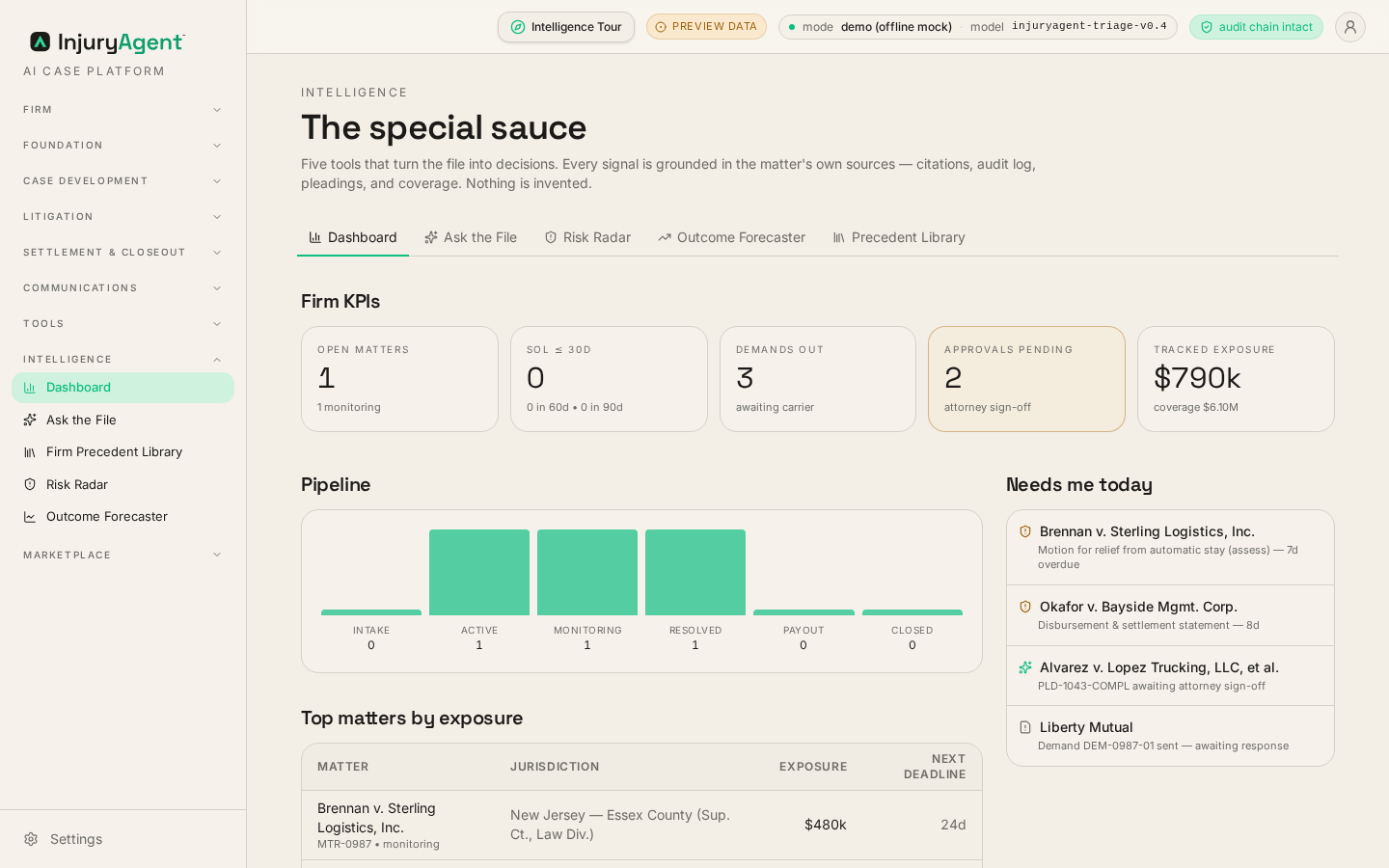
Every fact, document, communication, deadline, and dollar lives on a single matter record with an explicit lifecycle. When a matter enters Monitoring, it keeps watching for events that would re-open it — defendant bankruptcy, referral status, settlement-condition triggers.

Matter lifecycle · state machine
  1. State 1

    Intake

    Triaged, conflict-checked, assigned.

  2. State 2

    Active

    Liability, medicals, damages, discovery in motion.

  3. State 3Watching

    Monitoring

    Watching for events — defendant bankruptcy, referral, status change.

  4. State 4

    Resolved

    Settlement reached or judgment entered.

  5. State 5

    Payout

    Liens negotiated, trust accounting, client disbursement.

  6. State 6

    Closed

    File closed, retention clock starts, record stays durable.

Re-openMonitoring → Active: triggered by defendant bankruptcy, coverage change, statutory trigger, or attorney-flagged event. The matter doesn’t quietly disappear.
Per-matter timeline

Facts, documents, comms, deadlines, financials — one stream.

The timeline is the matter’s source of truth. Every entry is audit-logged with actor, timestamp, and source — so the record holds up to a future motion, a future audit, and the next attorney who picks up the file.